For over three decades, Christmas never really meant a day off.
That lesson came early. I was sixteen years old in 1977 when I landed my first tax-paying job at a local radio station. Sunday afternoons were spent sitting in a small booth while the New Orleans Saints played. When the broadcast cut to local commercials, my job was to play the spots that had been bought and paid for. Once an hour, I was given five seconds for station identification, and those five seconds felt like forever.
“You are listening to WHSY AM, Hattiesburg.”
That was my debut.
Eventually, I moved into weekend shifts, and I was ecstatic. I later learned that none of the other DJs wanted to work weekends, which probably explains how I got the job, but at the time it felt like a promotion earned the hard way. Then came the shift no one wanted—six o’clock Christmas Eve night until six o’clock Christmas morning, followed a week later by six p.m. New Year’s Eve until six a.m. New Year’s Day.
In those days, radio shifts were four hours long, and a twelve-hour shift was unheard of. But I was sixteen and hungry for airtime, so I took whatever they would give me. I worked those overnight shifts two years in a row—my junior year and senior year of high school—and I loved every minute of it.
Those long, quiet hours shaped how working Christmases felt to me. The holiday wasn’t about time off; it was about showing up. That outlook stuck.
Work has been steady since those late-seventies days, with one rough patch in the early eighties when jobs came and went. Finding work wasn’t the problem; keeping it was. Getting clean and sober in 1983 changed everything. Since then, there hasn’t been a stretch without work, and my gratitude for that has never faded.
After flunking out of college, I fell backward into the restaurant business and fell in love with it at the same time. Bills needed paying, so any shift was fair game. Christmas Eve and Christmas Day were no different. If the doors were open, I was working.
When the first restaurants opened—the Purple Parrot Café and the Purple Parrot Grill—we were open on Christmas Eve. Those early years meant ninety-hour weeks in the kitchen. We were closed on Christmas Day, and that day belonged to family. There weren’t many days off back then, but Christmas Day felt familiar, and it reminded me of those radio years.
Eventually, I made the decision to close on Christmas Eve. By then, I had pulled out of the kitchen and cut my schedule down to something closer to seventy hours a week, and I started taking Christmas Eve off while the team worked. After a couple of years of that, it didn’t sit right. I felt like Scrooge. We’ve been closed on Christmas Eve ever since. This year, only the bakery will be open, and even then, it will be a short day.
Christmas in the restaurant business carries a different kind of energy. Like retail, we’re busier than normal. December doesn’t make our year the way it does for some industries, but it’s still a strong month. These days, it also means private parties—friends, families, and companies filling our rooms and wanting things to feel special. It’s a good kind of tired.
Christmas parties for our team have always mattered to me. Before owning restaurants, most of the holiday parties I experienced were pretty lame. As a newbie in the workforce, I remember thinking that now that I had a real job and a professional position, a high-dollar Christmas bonus like the ones executives got on television shows was surely coming.
I got a fruitcake.
It didn’t make it home. It went straight out the window into the Leaf River as I crossed the bridge. Sixteen-year-olds don’t want fruitcake, and I’ve held a grudge against that foodstuff ever since.
The Purple Parrot Café opened on December 27, 1987, and we were far too busy to think about hosting a Christmas party. We made up for it with Christmas in July instead—a barbecue at a water park with live music and ribs. That day also happened to be when I met my wife. We’ve been together ever since. From that point forward, Christmas parties became non-negotiable.
It has taken me far too long to realize something obvious. Next year, for the first time ever, all of the New South Restaurant Group concepts will celebrate Christmas together. More than 450 teammates will gather in one room for one party. The concepts have always operated well, but mostly independently, and that’s changing. It’s overdue.
Christmas shows up differently in each restaurant, and that’s part of the fun.
For thirty-two years, the Purple Parrot Café handled the holidays with restraint, using tasteful touches like jingle bells tied with logo-branded ribbon and placed gently around guests’ necks. That restaurant didn’t survive COVID. In its place now stands the Maple Bar, where the Christmas décor is elegant, understated, and intentional. It remains one of my favorite rooms I’ve ever created, and it’s rare that I sit there without saying—out loud or quietly to myself—“I love this room.”
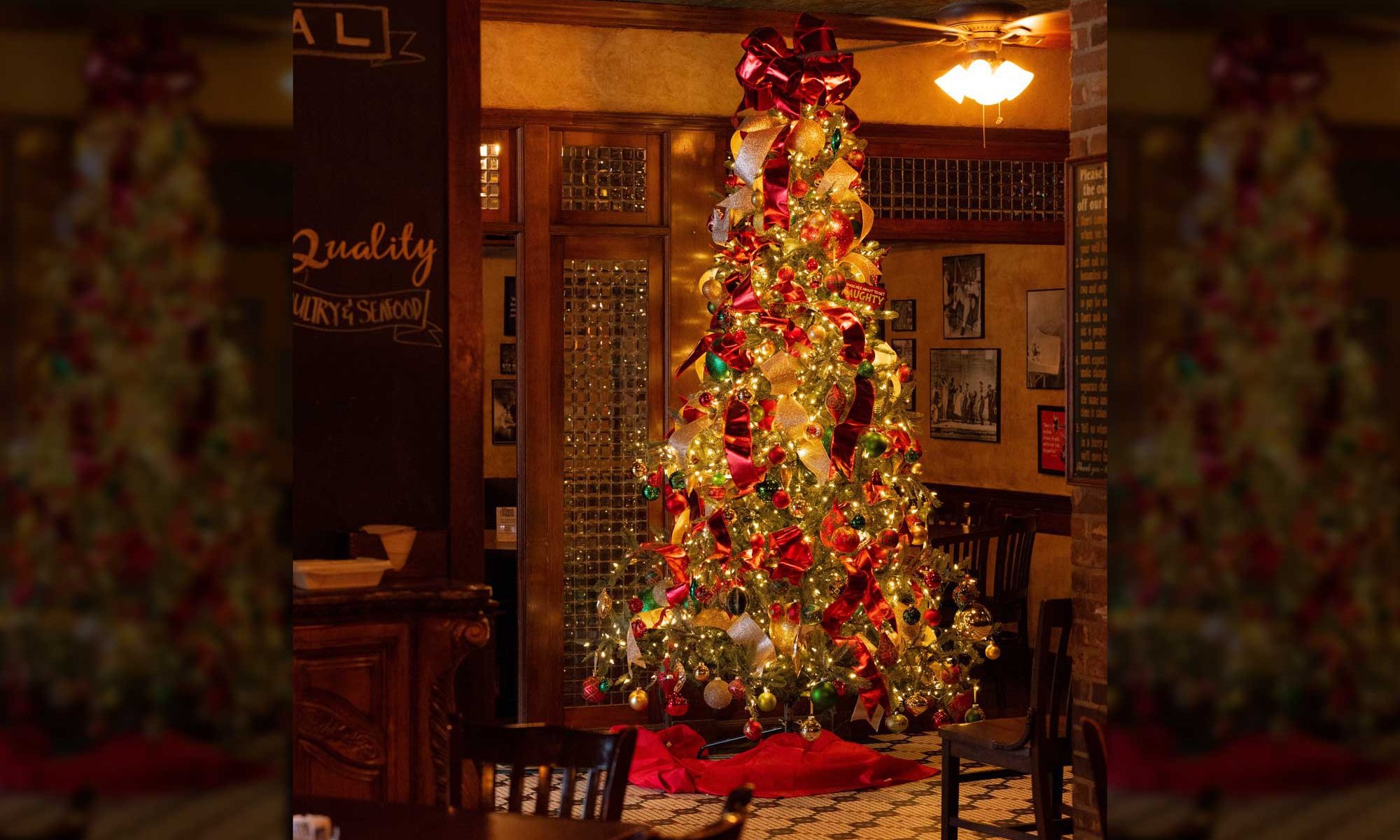
Crescent City Grill looks like Mardi Gras happened at the North Pole, festive without losing its footing, and ready to roll straight into Carnival on January 6. Mahogany Bar, along with Crescent City Grill, is one of our oldest continually operating concepts, and it is also the undisputed king of Christmas. Justin Jordan, who decorates all of our spaces, was given one directive: “I want it to look like Christmas threw up in here.” He delivered, enthusiastically and in the best possible way.
Loblolly Bakery leans into Christmas with a bakery-themed tree decorated in bread, butter, and whimsy. Ed’s Burger Joint goes all-in on retro, tacky Christmas, which somehow fits that room perfectly. Tabella keeps things quiet and understated. The Midtowner, which was designed to feel like it’s been there since 1948, features the only tinsel tree in my life these days. I grew up with tinsel everywhere, and Justin took pity on me and went all in.
None of this is accidental. Décor matters because feeling matters. Restaurants don’t just sell food; they sell moments and memories, and Christmas just turns the volume up.
As the season rolls along, gratitude sits front and center—for work, for teammates who show up, for guests who choose to spend meaningful moments in our rooms, and for the chance to help those who need it most. Extra Table exists to feed Mississippians facing food insecurity, and Christmas is the right time to lean into that mission. More information can be found at extratable.org.
Wishing everyone a Merry Christmas, filled with warmth, shared tables, and grateful hearts.
Onward into the New Year.