PETROGNANO, TUSCANY— Most of the people I pick up at the Florence airport have never met each other. By the end of the week, some of them will be friends for life. That part I didn’t plan. None of it was on the itinerary.
Fifteen years ago, my family and I landed in Stockholm, bought a Volvo, and started running hard across Europe with no plan other than to see everything we hadn’t seen. Six weeks in, we’d covered 11 countries. After a quick stint in Austria, we drove down into Tuscany where we settled for two weeks.
It had taken me two years to plan that six-month trip. The longest stretch I gave to any single location was right here—in the Tuscan hills south of Florence, in a tiny village called Barberino, which the Italians have since renamed Barberino-Tavarnelle, apparently because one town name wasn’t complicated enough to pronounce after two glasses of Chianti.
I’m not sure why I gave Tuscany the most time. Maybe it was the research. Maybe it was instinct. Whatever it was, it was the right call.
And it has shaped the rest of my life.
Those first two weeks, we became familiar with the village. L’americano che mangia tanto—the American who eats a lot—likely became my unofficial Italian name among the locals. We got to know Paolo, who owns the restaurant where everyone gathers. The old couple at the greengrocer on the square. The ladies at the bakery who saved us the good pastries. It wasn’t friendship yet. It was familiarity—the first step, but an important one.
In the years that followed, we kept coming back. Same villa, same view: thirty miles of cypress, grapes, and olives heading west toward the Mediterranean, sunsets worth every mile it took to get here. Barberino is small and remote, and that remoteness is the whole point. When I bring my tour groups here, we are the only tourists in the area. If someone were riding a horse down one of these roads five hundred years ago, the countryside would look identical to what we see today.
A mile’s walk from our borgo takes you past an Etruscan tomb, a memorial to Saint Catherine, several farmhouses, a villa where German officers headquartered in 1944 and scars from American tanks as the Allies push north, remnants of the mezzadria—the sharecropping system the Italian government broke up in the 1960s—a spring that saved a saint, towers built seven centuries ago by the Medici family, and a chapel dedicated to Saint Michael, erected in memory of a town that no longer exists. Semifonte was a medieval city, once a rival to Florence, that Florence besieged and razed to the ground in 1202. Florence has always had strong opinions about competition.
All that history within a short mile of where my guests wake up every morning.
Over nearly ten years of hosting Yonderlust tours—more than seventy trips, more than fifteen hundred people, minus two years for COVID—I’ve watched the same thing happen every single time. Strangers become familiar. Familiarity becomes friendship. Friendship becomes something I still don’t have a clean word for. Comunità, maybe. The Italian word for community, which sounds better than anything in English.
Most of the transformation happens at the table. Every morning, breakfast is made in the villa. Claria—who may be the only person on the entire continent of Europe who understands how to cook bacon properly—handles the eggs and the morning. Everywhere else in Europe, the bacon is essentially wet, uncured, unsmoked pork served at room temperature, which is fine if you’ve already given up. Claria’s eggs are soft and creamy with Stracciatella cheese. Over those breakfasts, people don’t just share a meal. They share their lives—their kids, their grandkids, their neighbors, their worries. Mississippians are genetically incapable of sitting at a table for twenty minutes without establishing that your mother’s college roommate’s first husband is somehow related to their deceased dentist, and they consider it a personal failure if the connection takes longer than ten minutes to establish. I call it, “diggin’ up kin.”
We eat twenty-one meals together over the course of a week. Lunches and dinners at local restaurants—places that don’t have English menus, places that have no idea what a tourist looks like, places I discovered the hard way over fifteen years of showing up and eating everything. That’s the real Tuscany. Not the postcard version. The version where the owner brings out a dish you didn’t order because he thinks you need it.
By midweek, the group doesn’t feel like strangers anymore. By the end of the week, people are exchanging phone numbers and planning reunions. Some of them follow through. More than you’d think. They meet in someone’s lake house for a weekend. They drive to each other’s hometowns. They show up when someone gets sick or loses a husband. That’s when you know it crossed over into something else.
A couple of years ago, I was in one of my restaurants and noticed eight women at a table—all of them had traveled with me before. Some were on their fifth, sixth, seventh trip. Laughing like they’d known each other since elementary school. I stopped and asked how many had known each other before traveling with me.
None of them.
Something came over me in that moment. Not pride. Something I didn’t have a word for then and still don’t. Eight women laughing like girls, none of them strangers anymore, all of them strangers when they landed. That was never the plan. The plan was pasta. The plan was Chianti and hill towns and a Florentine steak big enough to humble a grown man.
Friendship wasn’t on the itinerary.
The friendships were a surprise. How deep they went was a bigger one. People who met on a Tuesday in the Florence airport are now in each other’s lives — the kind of friendship you thought you could only make before the age of twenty.
A lot of the women who travel with me are recently widowed or recently divorced—women whose husbands handled the travel or didn’t want to travel, and who are now, sometimes for the first time in decades, figuring out what they want to see and who they want to be.
One woman pulled me aside on a recent tour and told me that during the darkest stretch of her life—several tragedies in quick succession—she’d lost her will to keep going. She said it was on one of these trips where she realized she still had so much ahead of her. She’s become one of my favorite people to travel with. Sharp, happy, always smiling, open to everything.
That wasn’t why I started doing this. But it’s why I’ll keep doing it.
Back home, we all move through the world surrounded by familiar faces—the person at the coffee shop, the neighbor you wave to on the way to the mailbox. Those aren’t friendships. They’re landmarks. Real friendship is the childhood kind, the ones that have survived six decades and still show up on a Tuesday for no reason. The adulthood ones are harder to make and harder to keep, but they’re there—through church, through work, through the dumb luck of being in the same room at the right time.
What I didn’t expect was a third category.
Scientists who study the Blue Zones—places where people routinely live past ninety—keep arriving at the same four factors: food, movement, sleep, and each other. The science is clear: loneliness shortens your life. Connection extends it. What they’re describing in those Sardinian villages, where people gather, argue, eat, and show up for each other decade after decade, is what I watch happen in a single week on these tours.
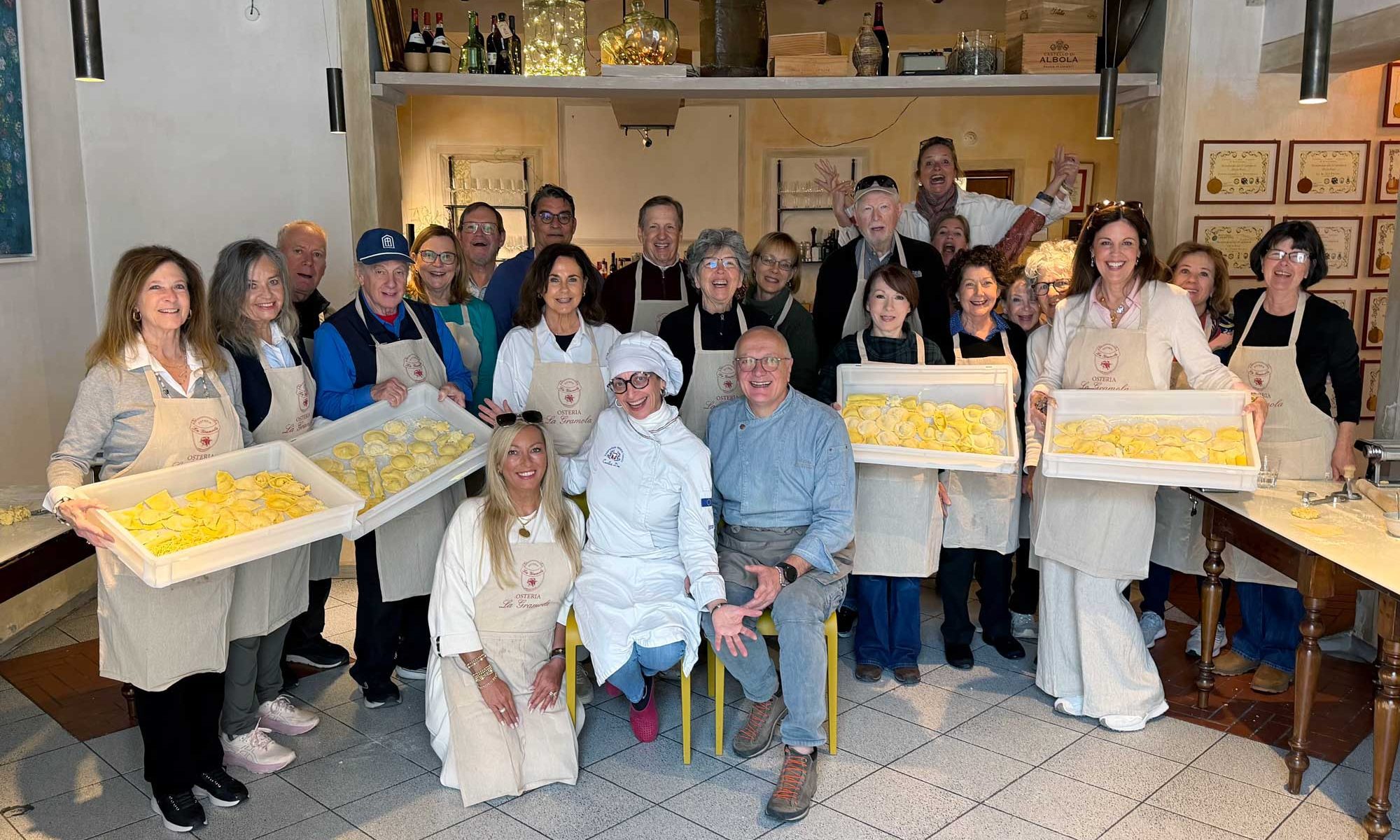
Sitting here this morning in the villa, waiting to take my group to learn how to make pasta before lunch in Siena, thinking about how a six-month road trip fifteen years ago led to this.
Familiarity. Then friendship. Then something deeper, something that doesn’t need a name.
For that, and for every person who’s pulled up a chair and stayed a while, I will always be grateful.
Onward.